
Efficiency and optimisation are key to the success of any business; more so now than ever as companies face rising costs and operate in increasingly competitive environments. This is leading to many organisations looking to streamline and automate the customer experience; making core elements digitally based. But what’s the key to balancing up this digital efficiency with retaining the levels of customer service that consumers need and expect, and what’s the role for a brand’s physical presence.
Brand Ignite’s latest research shows that consumers value digital channels for convenience, choice and routine activity. But when a decision becomes important, uncertain or difficult to reverse, they seek reassurance, expertise and tangible proof. Brands therefore succeed by allocating each channel a clear role rather than duplicating the same service everywhere.
7 ways that brands can win
1. Organise channels around customer needs, not cost
The dividing line is not simply “online versus offline.” It is low-stakes convenience versus high-stakes confidence.
For example, in a sector like banking, consumers lean towards digital for transferring money, but towards branches for mortgages, significant investments and major-life-event advice.
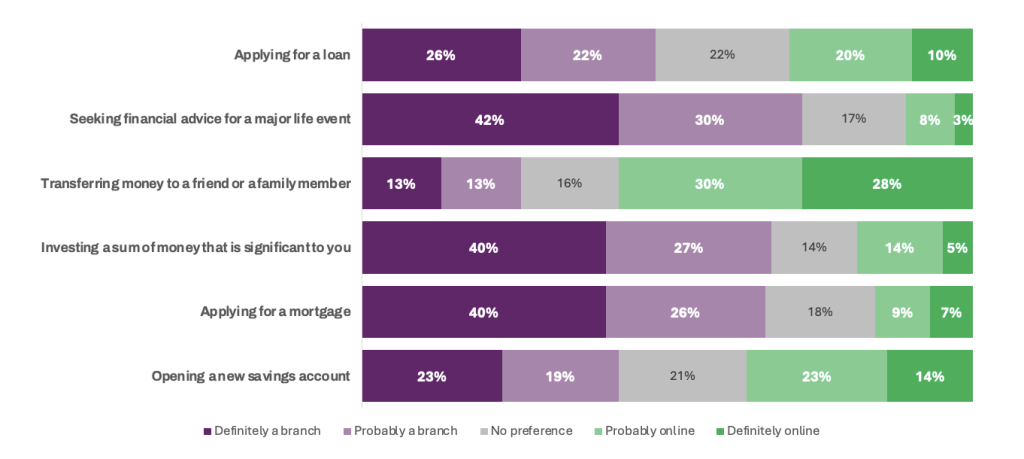
While in the retail sector, physical preference is strongest for products that need to be tried, examined or judged in context, including shoes, clothing, groceries and home furnishings.
A useful operating principle for brands could be:
- For routine, repeatable and reversible tasks make digital effortless.
- For complex, emotional or consequential tasks make human support prominent.
- And for the sensory or experiential tasks retain a physical proof point.
2. Treat human support as a safety net, not just another channel
In our research we see that only 51% say they actively use bank branches, yet 73% gain peace of mind from knowing branches exist and 76% trust branch staff more than digital tools to solve complex issues.
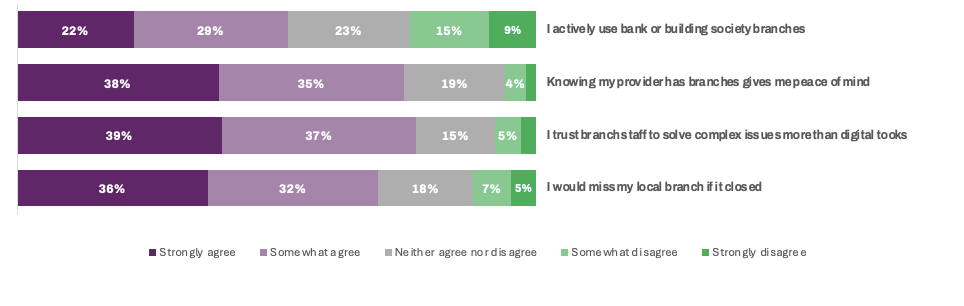
This gap is important. It shows us that a physical presence can create value even when it is not frequently used. For consumers it communicates key messages such as “Help exists if something goes wrong” or “Someone is going to take responsibility” or “I will not be trapped in an automated process”.
This suggests that closing a location based solely on transaction volumes risks overlooking the value it brings through trust and reassurance.
3. What does your brand mean by human support
Our Brand Ignite data shows that if branches in financial services closed, more people would miss face-to-face conversation, accessible help and somewhere to resolve a complex issue, more so than personalised service from familiar faces.
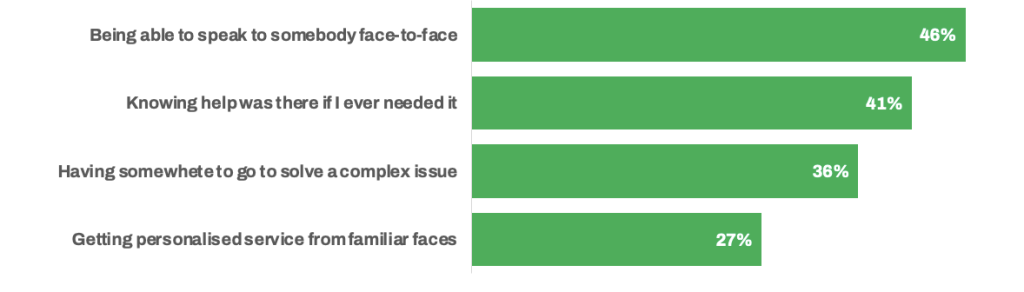
So it is not about going to physical locations to see the same person each time who knows your name. For brands it’s about human qualities like judgement and accountability.
For example,
- Judgement - understanding that there are situations that don’t fit the standard process
- Empathy - recognising anxiety, vulnerability or uncertainty
- Accountability - taking ownership rather than redirecting the customer
- Expertise - ability to help with decisions where mistakes carry consequences
- Reassurance - confirming that the customer is making an appropriate choice
Artificial Intelligence can support these qualities by giving employees access to better information, but it can’t simply replace them without changing what the customer experiences and that impacts their view of your brand.
4. Make escalation central to the digital design
A digital service is not genuinely convenient if customers can’t get resolution when there are problems or it fails.
Our branch-closure research findings show that there is demand for help when digital banking is not working, support for the less digitally confident consumers and a need for a place to solve complex problems.
Brands therefore need to build visible escalation routes into their digital journeys. This could be scaled in a way that offers:
- Self service for straightforward needs
- Live human help without the need to restart the journey
- Specialist support for more important and consequential decisions
- A physical option when remote resolution is not possible
5. Give physical locations a more valuable job
Physical locations do not need to compete with digital channels on speed or range. They can specialise in what the digital route finds harder to provide. For example, expert advice, complex problem resolution, product trial and demonstration, inspiration and discovery or memorable or social experiences.
In retail, 73% agree that stores reveal product nuances that images cannot, 68% say store visits make them more confident about purchasing and 67% value trying alternatives before buying.
If retail stores closed, customers would miss trying multiple sizes, seeing the products in real life and finding inspiration.
This supports an approach based on fewer, but more purposeful locations, rather than maintaining stores that simply hold stock and process payments.
6. Let digital and physical complete the same journey
Consumers already behave in an omnichannel way. Around half report researching online before buying in-store, while two-thirds examine products in-store and then purchase online for the best price.
Brands will succeed when they stop treating this behaviour as leakage and actively enable it through different means. For example through shared baskets and wish lists, accurate local stock information, click-and-collect and convenient returns, consistent prices and offers across channels and employee access to the customer’s digital journey.
The commercial objective becomes winning the whole journey, not forcing the final transaction through a particular channel.
7. Use each channel to solve the other’s weaknesses
Digital shopping performs strongly on delivery, range, comparison and price discovery. But consumers also associate it with uncertainty over legitimacy, difficult returns and the sense that purchasing can be a gamble.
Physical shopping brings confidence and tangibility, but suffers from stock limitations, concern about getting the best price, travel and overstimulation.
The strongest proposition combines them with the digital channels supplying speed, information and range, the physical ones supplying confidence, experience and resolution and human support offering trust and accountability.
A way for brands to frame their channel strategy would be around three connected layers:
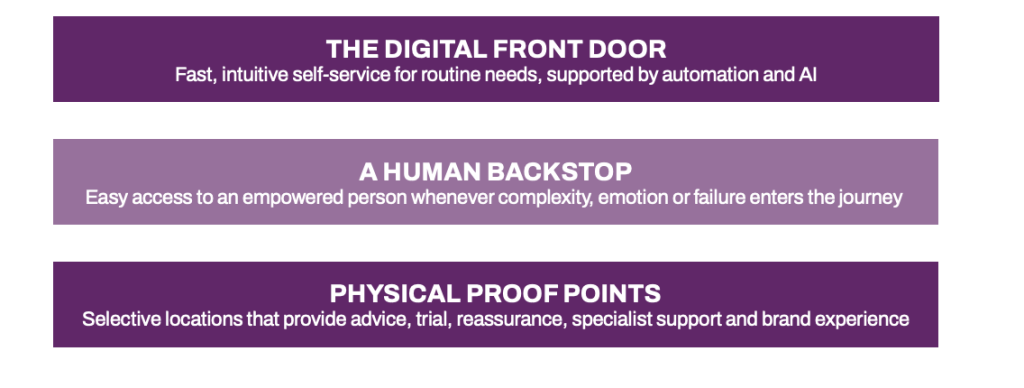
The presence of all three does not mean every customer uses every layer. It means customers can move to the level of support appropriate to the moment.
This framework may need brands to measure different metrics to assess success.
For example, metrics like a measure of resolution of complex cases, customer confidence after interaction, trust and retention and conversion after advice or product trial should be combined with cost-per-transaction and footfall to give a more rounded view of success.
Final Thoughts
In essence, the research shows that efficiency and humanity are not opposing strategies. The winning brands will not be those with the most branches or the most automation. They will be those that make digital effortless, human support unmistakably available and physical experiences worth the journey.
Research conducted by Brand Ignite in October 2026. 500 online survey completes. National representative sample (UK).
Photo credit: Cam Morin